What the veneer actually does in a door panel
Veneer performs two separate jobs in a door panel, and the requirements for those two jobs have almost nothing in common.
The outer face is what people see. After pressing it sits under paint, lacquer or foil — and even an opaque finish does not fully hide a knot, a split or a joint. A defect on the face is a defect in the finished door.
The inner plies are never seen. Their job is to give thickness, keep the panel flat and carry the glue. Grades 3–4 belong here, and nothing is lost by putting them there.
That distinction decides the whole purchasing question.
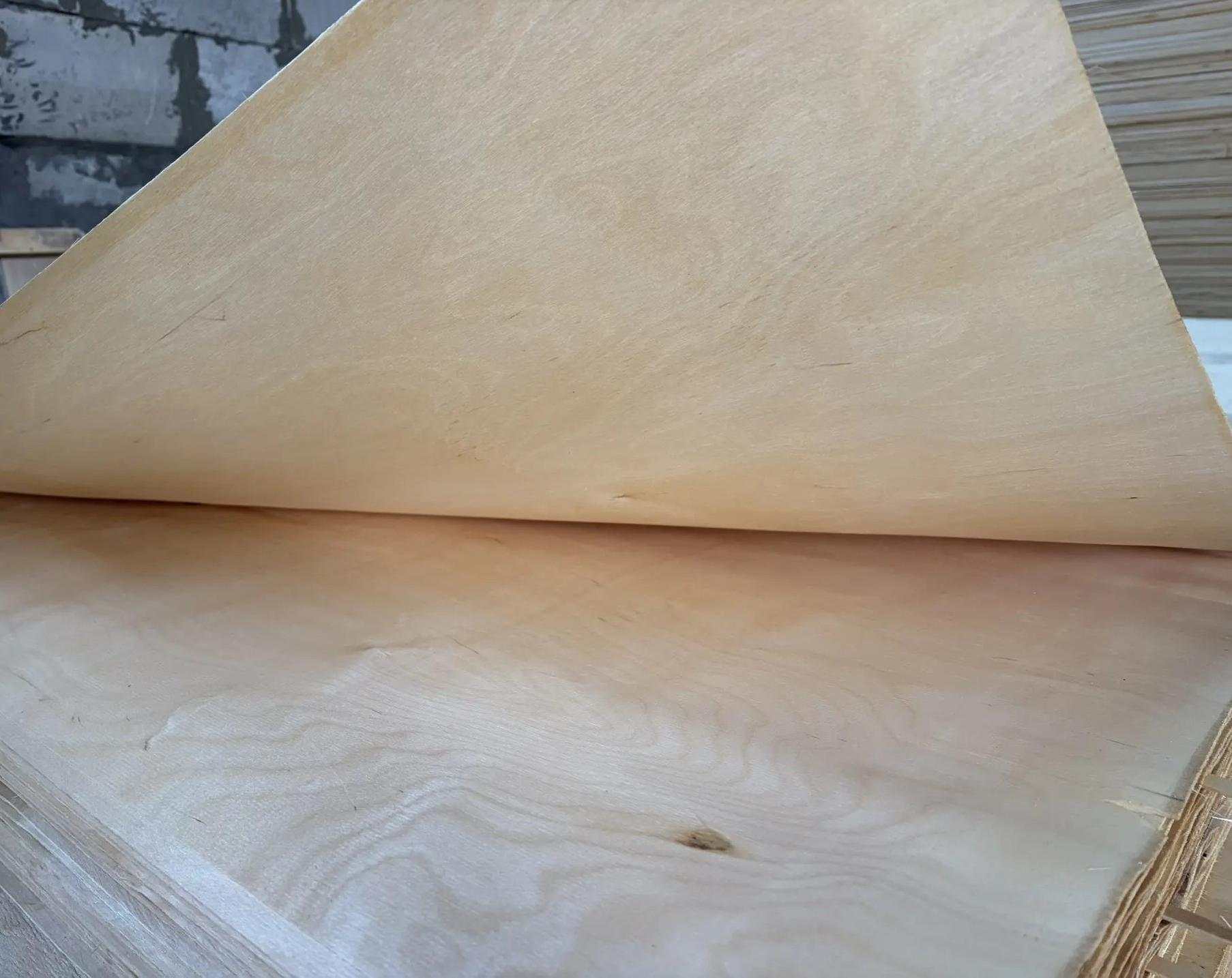
Mixed batch or graded: the arithmetic
A mixed 1–4 batch yields 22–27% grade 1–2. In round numbers: buy 4 m³ of mixed and you sort out roughly 1 m³ of face veneer. Two scenarios follow.
| Buy mixed 1–4 and sort | Buy graded 1–2 | |
|---|---|---|
| List price | 17,500 ₽/m³ | 35,000 ₽/m³ |
| Volume needed for 1 m³ of faces | ≈ 4 m³ | 1 m³ |
| Amount paid | ≈ 70,000 ₽ | 35,000 ₽ |
| Grade 3–4 left over | 3 m³ | none |
| Volume shipped | 4 m³ | 1 m³ |
| Freight at 90–120 USD/m³ | 360–480 USD | 90–120 USD |
The decision reduces to one question: what happens to the leftover 3 m³?
If your plant builds the whole panel — if you lay up the inner plies yourself — the leftover is not waste, it is raw material. In that case the mixed batch is clearly cheaper and there is no reason to pay for grading.
If you only face pre-made panels and buy the core elsewhere, those 3 m³ stay on your floor. If you can sell them the two options roughly break even; if you cannot, graded veneer is distinctly cheaper — and you ship a quarter of the volume.
Why birch rather than poplar
Poplar veneer is common in the door industry, and in the core it is entirely the right choice. On the face the picture changes.
| Criterion | Birch | Poplar |
|---|---|---|
| Density | 620–680 kg/m³ | markedly lower |
| Bending strength | 120–144 MPa | lower |
| Impact marks on the face | resists | marks easily |
| Colour | pale, uniform | grey-green streaks |
| Behaviour under paint | predictable | streaks can read through |
| Price | higher | lower |
A door face takes impact for the life of the product — in transit, during installation, in daily use. The density difference becomes visible exactly there: a knock that dents poplar leaves birch unmarked.
The second difference is colour. Birch is pale and uniform and finishes predictably. The full comparison of the two species is on the birch versus poplar page.
Moisture: why panels come out of the press blistered
Heat cures the glue in the press. If the veneer carries excess water, that water turns to steam and collects at the glue line — and the panel comes out blistered. The fault is usually not in the press settings but in the moisture of the input.
Our band is 5–8%. It is measured before dispatch and written on the shipping document, so the declared figure is something you can check on arrival. Why the band is held there and how it is measured is covered on the moisture content page.
One warning: veneer picks up moisture in transit and in storage. Material that leaves at 5–8% will reach your press at a different figure if it is kept in the open. That is why intact packaging matters — the packaging and moisture protection page covers it.
Choosing thickness
| Thickness | Where | Why |
|---|---|---|
| 0.9 mm | Outer face | cheapest per m²; telegraphs the substrate least |
| 1.2 mm | Outer face, intermediate ply | balance of face durability and cost |
| 1.5 mm | Inner ply, structural | the standard industrial thickness |
| 1.7 mm | Inner ply | fewer plies, faster lay-up |
Tolerance is ±0.1 mm at every thickness. Two different thicknesses can travel in the same container — thin for faces, thicker for the core, planned as a single shipment.
What to send us for a quote
Four pieces of information are enough:
- Your panel dimensions — this decides whether cut-to-size veneer makes sense.
- Faces, core, or both — this decides the grade.
- Thickness — separately for faces and for inner plies.
- Monthly or annual volume in m³ — for batch planning and colour consistency.
With those four we will run the mixed and graded scenarios side by side and tell you which is cheaper for your case. If the answer is the mixed batch, we will say so — selling the more expensive option has never worked out well for anyone in the long run.