HUŞ KAPLAMARotary-cut birch veneer from Russia

Rotary-cut birch veneer 1300×1300 mm

The 1300 × 1300 mm square fills a container more densely than any other sheet format: 40 m³ into a 40'HC at 66.4% floor utilisation. The price is the same as for the other sheets — 17,500 ₽/m³ ex-works. The format goes to small and medium presses, to combi-panel cores and to packaging production. A sheet covers 1.69 m² and weighs about 1.65 kg, so it is easy to carry and to feed by hand — which is what decides it in shops with limited forklift access. This is a format that runs into the weight limit: 40 m³ weigh roughly 24.8–27.2 t.

40
Into a 40'HC
15,779 sheets at 1.5 mm
66.4%
Floor utilisation
best of the sheet formats
~1.65kg
Weight of one sheet
1.69 m², one person carries it
17,500₽/m³
Price ex-works
≈ 219 USD/m³
size
1300 × 1300 mm ±5 mm
one sheet
0.002535 m³ · 1.69 m²
1 m³
394 sheets · 667 m²
gross
24.8–27.2 t
moisture
5–8%
grade 1–2 share
22–27%
density
620–680 kg/m³
HS code
4408.90

Where this format earns its place

1300 × 1300 mm is the most practical size in the range — not the best seller, but the one that nothing else replaces in certain types of production.

  • Small and medium presses. If the platen does not reach the 1600 mm square, this is the right size.
  • Combi-panel cores. Where birch goes on the face and a cheaper layer goes inside, the inner format is usually smaller.
  • Packaging, crates, pallet components. Appearance requirements are low and the unit cost decides.
  • Shops with manual feeding. A sheet is 1.69 m² and about 1.65 kg — one person carries it comfortably. A 2600 mm sheet takes two.
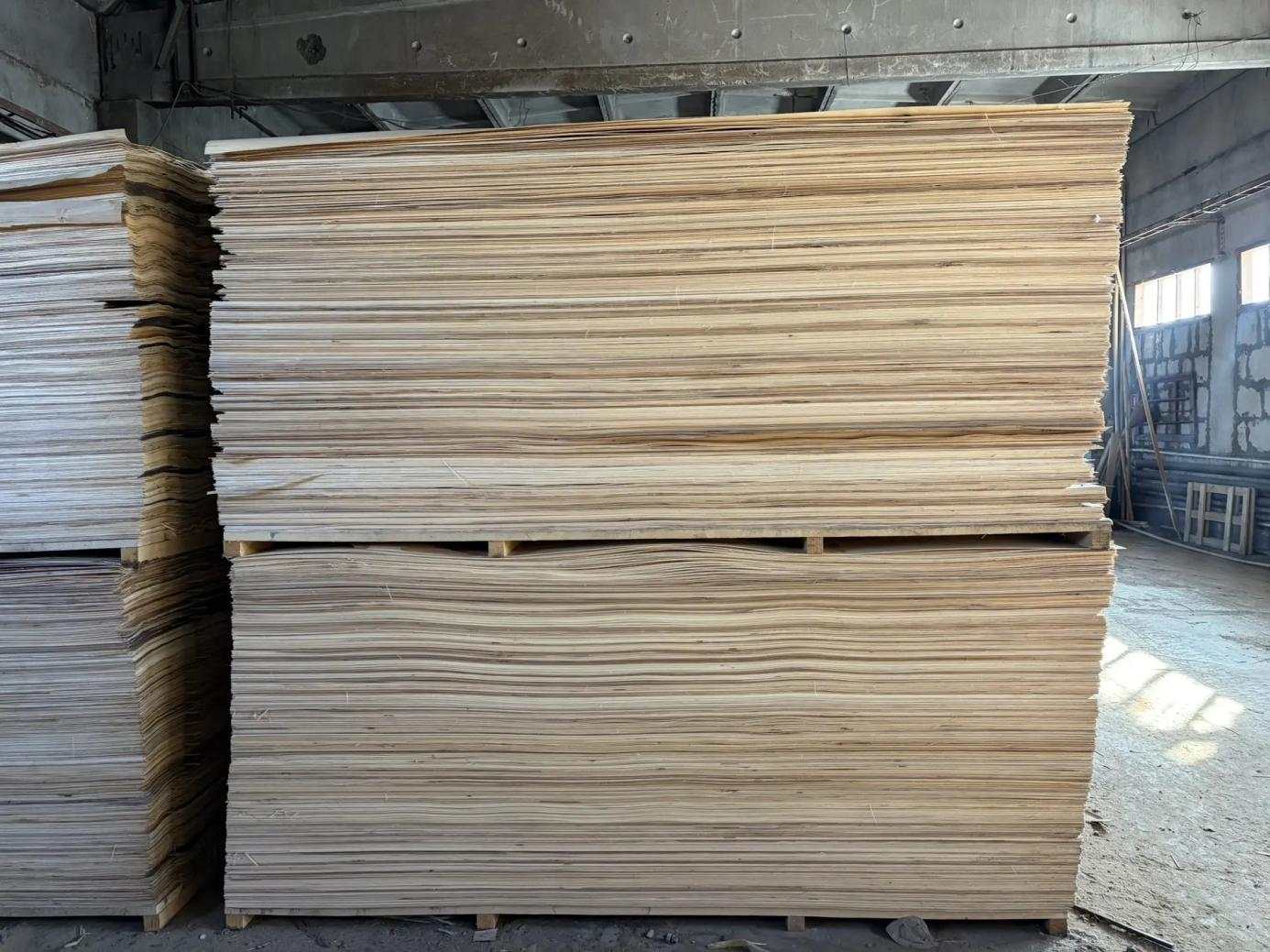
Graded veneer bundles stacked in the workshop

Technical specification

ParameterValue
Size1300 × 1300 mm (±5 mm)
Thicknessnominal 1.5 mm; band 0.9–1.7 mm (±0.1 mm)
SpeciesBirch (Betula)
Moisture content5–8%
GradeMixed 1–4, grade 1–2 share 22–27%
Density620–680 kg/m³
Bending strength120–144 MPa
GTİP (Turkish customs tariff code) / HS4408.90
One sheet0.002535 m³ · 1.69 m² · ~1.65 kg
1 m³394 sheets · 667 m²
40’HC container40 m³ · 15,779 sheets · 24.8–27.2 t
Floor utilisation66.4%
Price17,500 ₽/m³ ex-works ≈ 219 USD/m³

Sheet count by thickness

Thickness1 sheet, m³Sheets per m³Sheets in a 40 m³ container
0.9 mm0.00152165726,298
1.2 mm0.00202849319,724
1.5 mm0.00253539415,779
1.7 mm0.00287334813,923

The three sheet formats side by side

2600 × 13001600 × 16001300 × 1300
Net into a 40’HC33 m³38 m³40 m³
Floor utilisation47.8%63.3%66.4%
Gross weight20.5–22.4 t23.6–25.8 t24.8–27.2 t
Weight of one sheet~3.3 kg~2.5 kg~1.65 kg
Price per m³17,500 ₽17,500 ₽17,500 ₽
Freight per m³120 USD104 USD99 USD

The weight limit

In this format 40 m³ weigh roughly 24.8–27.2 t and run into the payload of a 40’HC, which is usually 26–28 t. The practical conclusion: here the container works at full capacity, and adding more cubic metres is no longer possible.

If a lot comes in at the top of the density band (680 kg/m³), confirm your carrier’s line weight limit before loading — on some services the maximum accepted gross weight is lower.

Ordering

Send us your press platen size, the size of your finished panel and your monthly requirement in cubic metres. We will lay the waste and freight calculations for all three sheet formats side by side and show you which one comes out cheaper on your production line.

FAQ

Frequently asked questions

How many cubic metres of 1300x1300 veneer fit in a container?

A 40'HC takes 40 m³, which is 15,779 sheets at 1.5 mm. Floor utilisation of 66.4% is the best result among the sheet formats. Gross weight is 24.8–27.2 t, so this format runs into the container's weight limit.

When is this the format to choose?

In three cases. If your press platen is too small for the 1600 mm square. If you make combi-panel cores. If you produce packaging and crates, where appearance requirements are low. There is also a separate case: shops with manual feeding, where the weight of the sheet works in your favour.

How many 1300×1300 sheets are there in a cubic metre?

394 sheets at 1.5 mm; one sheet is 0.002535 m³ and 1.69 m². At 1.2 mm you get 493 sheets, at 0.9 mm 657, and at 1.7 mm 348.

Does it make sense to take this instead of 1600×1600?

Container loading is slightly higher — 40 m³ against 38 — but the difference is small. What decides it is your press and the size of your finished panel. The 1300 mm square suits small presses and core layers; 1600 mm is for lines making wider panels. The cost of waste from the wrong size is larger than the freight difference between these two formats.

Is the price different from the other formats?

No. All three sheet formats are 17,500 ₽/m³ ex-works, excluding VAT, for mixed grade 1–4. The size you choose changes not the price per cubic metre but the number of cubic metres per container, and therefore the freight per cubic metre.

How much does one sheet weigh?

About 1.65 kg at 1.5 mm (0.002535 m³ × an average 650 kg/m³). That is a comfortable weight for carrying and for feeding the press; a sheet in the 2600 × 1300 format already weighs about 3.3 kg.

What is the minimum order?

In this format a full 40'HC takes 40 m³, and that is the usual starting unit. If you load a railcar, it is 102 m³. On a smaller lot the freight per cubic metre rises out of proportion.

Tell us the format, thickness and monthly volume

We will work out the cubic metres per container, the freight to your port and the lead time. We answer during Turkish business hours, in Turkish, English and Russian.

Author: Andrey, Turkey representative, HUŞ KAPLAMA · Published: · Updated: