Four numbers, one material
Birch is not first in any single category. What makes it so widespread in industry is that four properties coincide in the same tree.
| Property | Value | What it means in practice |
|---|---|---|
| Density | 620–680 kg/m³ | The surface resists impact and holds a screw; well above poplar |
| Bending strength | 120–144 MPa | Enough for load-bearing layers; this is why plywood faces are birch |
| Grain | Fine, uniform | Finishes predictably under paint and lacquer, the figure does not read through |
| Resin | None | Glue holds, the knife stays clean, the surface does not stain from within |
Taken one at a time none of these is remarkable. Together they make a raw material close to ideal for rotary-cut veneer — and explain why industrial plywood has been built on birch for as long as it has.
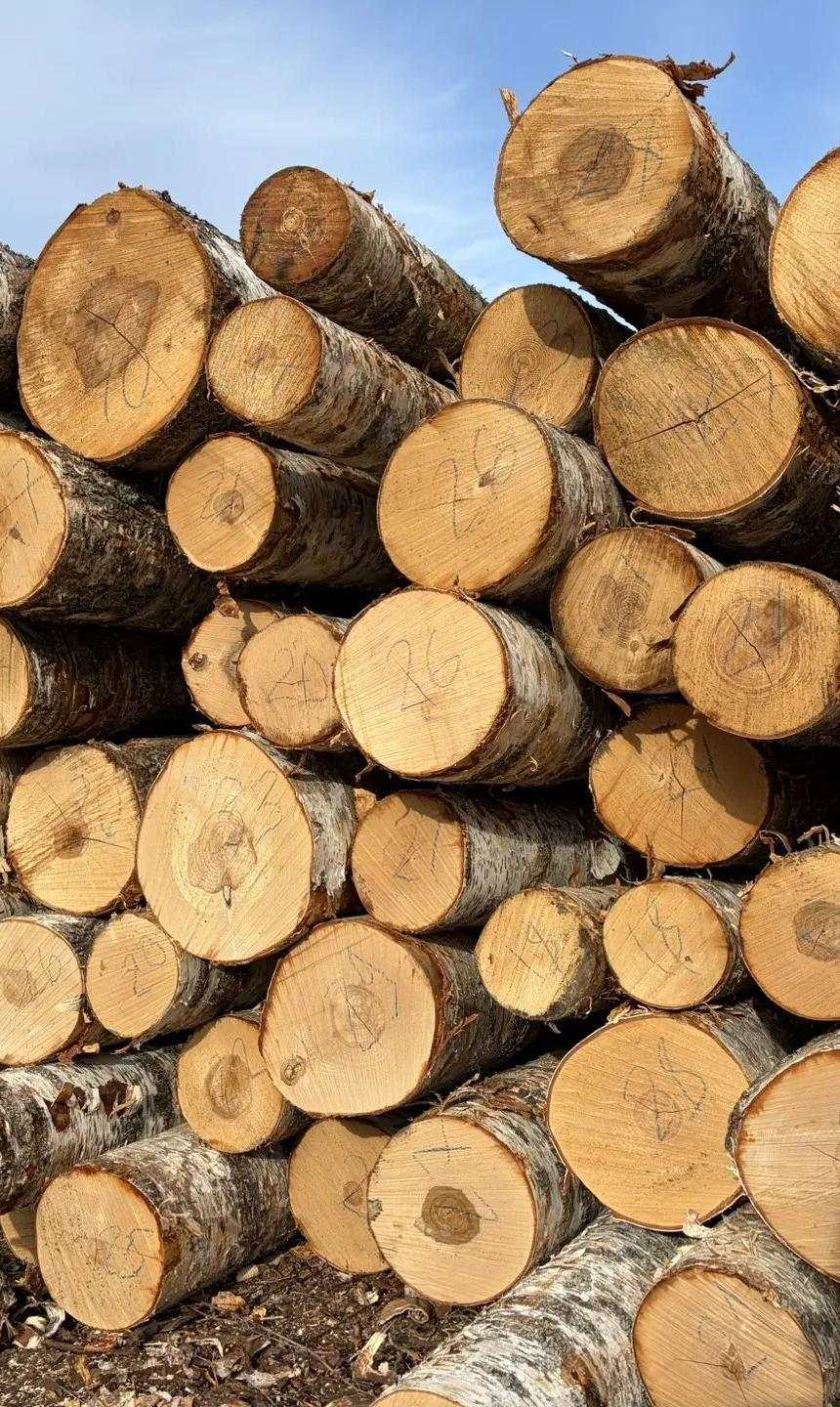
Species and range
The genus is Betula. Industry uses two species, and in practice they arrive together:
- Betula pendula, silver birch — generally a straighter stem, slightly higher density.
- Betula pubescens, downy birch — tolerates wetter and colder ground.
Their technical properties are close enough that veneer is not ordered by species; a mixed lot contains both.
The natural range is the northern temperate belt and the taiga: Russia, Scandinavia, the Baltic states, North America. Turkey has no industrial-scale birch forest — the species occurs only in the north-east, at altitude and scattered. The commercial consequence is direct: birch veneer and birch plywood are imported, whoever the buyer is.
Why it peels well
A rotary lathe asks four things of its raw material, and birch supplies all four.
- A straight, cylindrical stem. The log turns evenly; a crooked stem produces a ribbon of varying thickness.
- Short, even fibre. The ribbon comes off continuous — the single property that most determines peeling yield.
- Small, scattered knots. A large knot both tears the ribbon and lowers the grade.
- No resin canals. In resinous species the knife fouls and glue adhesion suffers; birch has no such problem.
The peeling process in full — from steaming to drying — is on the rotary-cut veneer page.
Behaviour under humidity
Birch takes up and gives off moisture, like every timber. What sets it apart is doing so relatively evenly: it moves less than beech, so once dried it holds its dimensions better.
The drying target for industrial veneer is 5–8%. There is no need to go below that band; going above it causes trouble directly, because excess water turns to steam in the press and collects at the glue line. How moisture is measured and why the band sits where it does is on the moisture content page.
Being pale and resin-free also leaves birch somewhat more open to fungal staining: where moisture meets still air, grey-blue marks can appear. Drying and sealed packaging close that off — the packaging page covers that side.
Side by side with other species
| Birch | Poplar | Beech | |
|---|---|---|---|
| Density | 620–680 kg/m³ | markedly lower | higher than birch |
| Stability under humidity | good | good | poor, moves a lot |
| Colour | pale, uniform | grey-green streaks | pinkish brown |
| Place in plywood | face and load plies | core | solid components, special uses |
| Local resource in Turkey | none | plentiful | limited |
The detailed comparison with poplar is on the birch versus poplar page, and with beech on the birch versus beech page.
Where it is used
Where birch veneer ends up follows directly from those four properties:
- Plywood — both face and core plies; strength decides here.
- Bent lamination — chair seats and backrests; the short fibre allows the bend.
- Door panels — the face ply; the uniform grain finishes predictably.
- Small parts and packaging — matches, sticks, crate components.
Each of these uses has its own thickness and grade preferences, set out on our product pages.