Two separate systems, confused constantly
This page exists because of a single misunderstanding. In Turkey buyers ask a supplier “do you have B/BB veneer?” — and the question is put the wrong way round.
Veneer grade (what we sell): grades 1, 2, 3 and 4. It follows log quality, the density of knots and splits, and surface cleanliness.
Panel face class (what you produce): B/BB, BB/BB, BB/CP, CP/CP, C/C. It describes the appearance of the two faces of the pressed panel.
The two are related — a good panel needs good face veneer — but they are not the same thing.
What the letters say
The notation always has two parts, separated by a slash: the first letter is the front face, the second the back face.
| Letter | Name | Surface condition |
|---|---|---|
| B | Good | Almost flawless. Small sound knots, slight colour variation. For surfaces that show |
| BB | Repaired | Knot holes closed with wood patches, surface even. The patches are visible |
| CP | Colour-patched | More patches than BB and a more pronounced colour difference. For surfaces to be painted or overlaid |
| C | Unrepaired | Open knot holes, splits and colour variation permitted. Hidden faces and structural use |
The common combinations and where they are used:
| Class | Front face | Back face | Typical use |
|---|---|---|---|
| B/BB | very good | repaired | Pale furniture, visible surfaces, interior fit-out |
| BB/BB | repaired | repaired | Furniture parts where both faces show |
| BB/CP | repaired | more heavily patched | Carcass furniture, parts with one face showing |
| CP/CP | patched | patched | Surfaces to be painted, packaging, structural work |
| C/C | unrepaired | unrepaired | Formwork, scaffolding, hidden structural use |
From birch veneer grade to panel class
Now the question that actually matters in practice: which veneer do I buy to make a B/BB panel?
Picture an eleven-layer, 15 mm panel. The number of visible layers is two. The remaining nine are never seen, and only two things are asked of them: strength and even thickness.
| Layer | Veneer grade required | Share of the panel |
|---|---|---|
| Front face (1 layer) | Grade 1 | 9% |
| Back face (1 layer) | Grade 2 | 9% |
| Inner layers (9 layers) | Grade 3–4 | 82% |
So for a B/BB panel roughly 18% of your requirement is high-grade veneer.
In our standard mixed 1–4 batch the grade 1–2 share is 22–27%. Even the bottom of that band sits above the requirement, which is why you do not need to buy face veneer separately. That is precisely the logic of the mixed batch: one order yields both the face and the core.
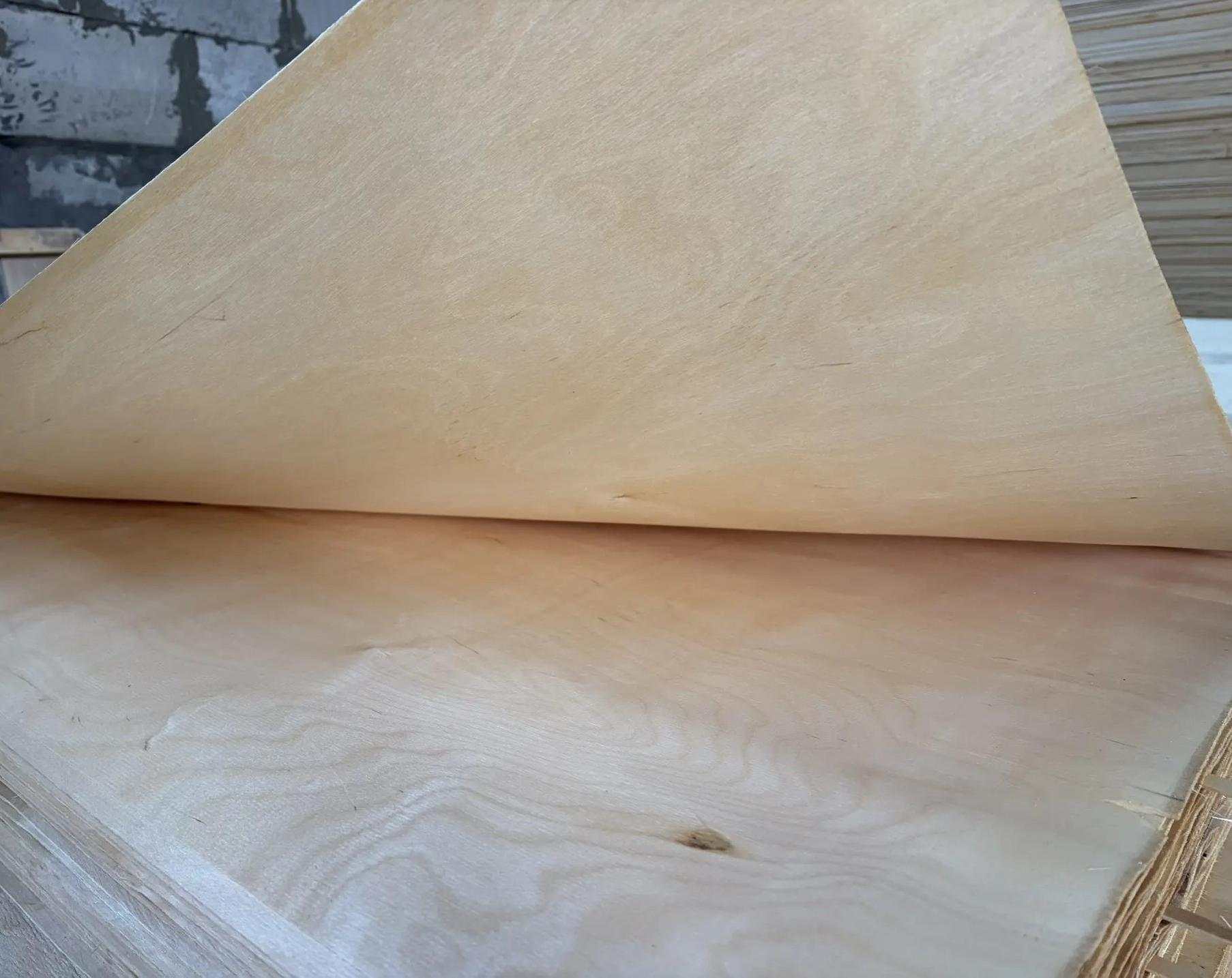
The veneer’s own grades
The product we sell is sorted like this:
| Grade | Surface condition | Where it goes |
|---|---|---|
| Grade 1 | Clean, sound, even in colour. Knots almost absent | Panel front face, door panels, furniture |
| Grade 2 | Small sound knots, slight colour variation | Back face, secondary surfaces that show |
| Grade 3 | Knots, small splits, colour variation | Inner layers |
| Grade 4 | Visible defects that do not affect strength | Inner layers, packaging |
Why we give a band rather than a single figure. Because the log itself varies. The 22–27% range is what we can realistically commit to batch after batch. Narrowing the band means tightening the sort and raising the price — which is why we also sell grade 1–2 as a separate product.
An emission class is not a grade
The second thing that gets confused. E1 and E0 describe formaldehyde release, not surface appearance.
Emission does not come from the veneer, it comes from the glue. You can produce either an E1 or an E0 panel from the same veneer; what decides it is your adhesive formulation. Asking a supplier for “E0 veneer” is therefore not a meaningful request.
Prices
Prices valid as of August 30, 2026. Prices exclude VAT, ex-works.
Price by grade — Applies to all formats
| Grade | USD/m³ · EXW | ₽/m³ · reference |
|---|---|---|
| Mixed 2–4 | $206 | 16,500 ₽ |
| Mixed 1–4 | $219 | 17,500 ₽ |
| Grade 1–2 | $438 | 35,000 ₽ |
| Grade 1 | $625 | 50,000 ₽ |
The list is kept in ₽; USD is converted at the 19 Aug 2026 rate (80 ₽/$). Contracts are in USD or EUR. · HS 4408.90 · MOQ 33 m³
More on grades and tolerances is on the quality page; the layer calculation and press lay-up are on the plywood production page.