Three systems that measure different things
The Turkish buyer asks which TS EN standard the material complies with. The Russian supplier answers: GOST 99. Both answers are correct, and the conversation stops there — because the documents describe different objects.
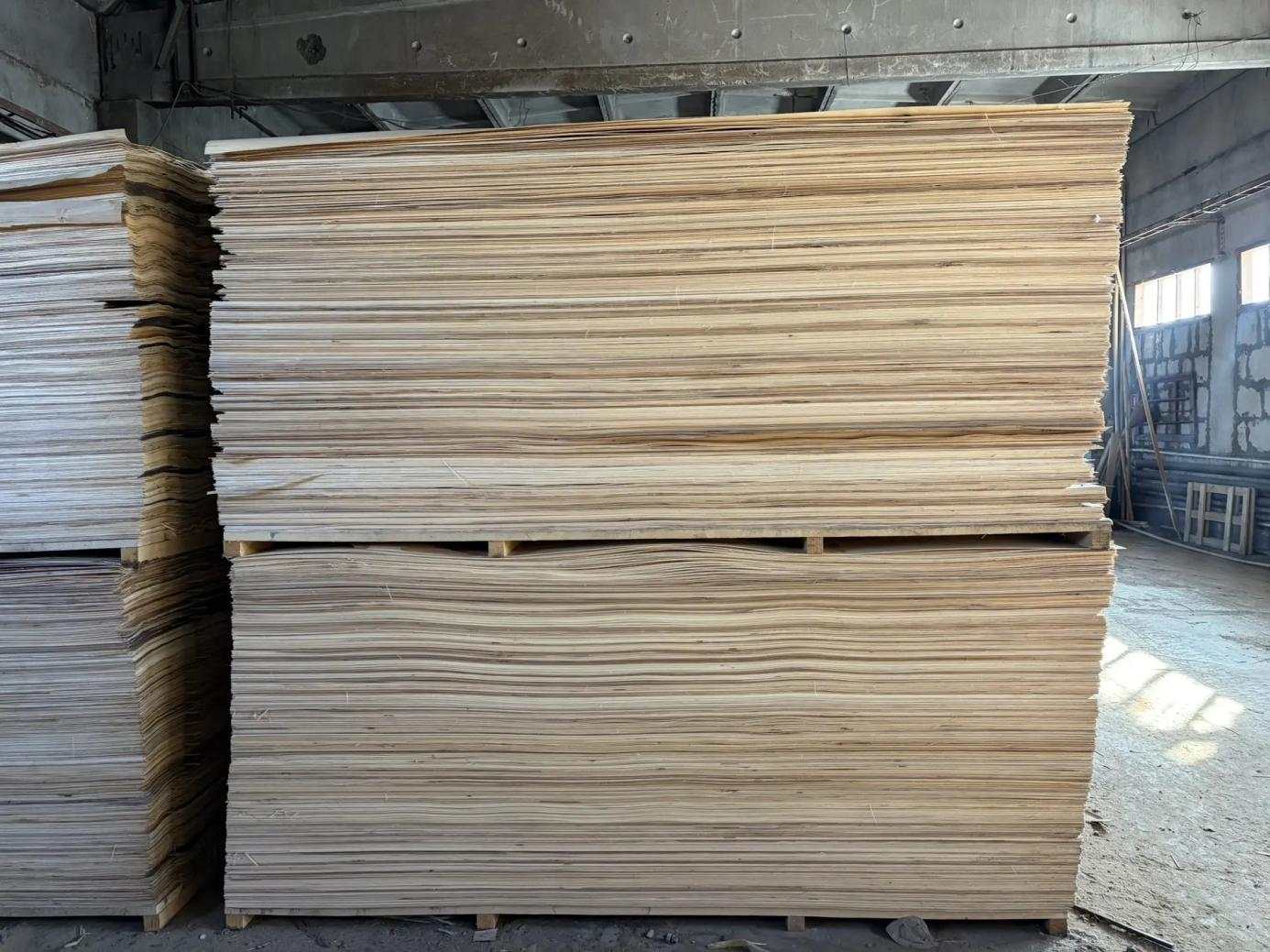
GOST 99, Rotary-cut veneer. Technical specifications governs the veneer sheet: knots, splits, bark pockets, colour variation, nominal thickness and its spread, moisture and sheet sizes. This is what we load into the container.
TS EN 635 governs the appearance of a finished plywood panel. Classes E, I, II, III and IV describe the panel face after pressing, repair of defects and sanding. That is what leaves your line, not ours.
B/BB, BB/CP and CP/CP are not a standard at all. They are a trade notation for the two faces of a pressed panel, inherited from Russian and European trading practice, and in Turkey they are used in conversation more often than the EN numbers. The letters are set out on the grades page.
TS EN is the Turkish edition of a European standard, published by TSE, the Turkish Standards Institution: the text of EN 635 and TS EN 635 is identical, and only the cover and the issuing body differ.
What GOST 99 governs, and our figures against it
| GOST 99 parameter | Our figure |
|---|---|
| Sheet grade | mixed 1–4 |
| Grade 1–2 share | 22–27%, and 50% in the 420 × 420 mm blanks |
| Nominal thickness | 1.5 mm |
| Thickness range | 0.9–1.7 mm on request |
| Moisture | 5–8% at shipment |
| Sheet formats | 2600 × 1300, 1600 × 1600, 1300 × 1300 mm |
| Timber defects | knots, splits, bark pockets, colour variation — limited by grade |
| Species | birch, Betula |
One detail that matters at customs and in correspondence with your customer: veneer moves under HS code 4408.90, plywood under 4412. The European plywood standards were written for the second code, and that is the shortest way to explain why they cannot be demanded of the first.
What each GOST 99 grade means
| Grade | What you see on the sheet | Where it goes in the panel |
|---|---|---|
| Grade 1 | Clean, pale, sound surface of even colour. Knots almost absent | Panel face, door skin, furniture front |
| Grade 2 | Small sound knots, slight colour variation | Back face, secondary visible surfaces |
| Grade 3 | Knots, small splits, noticeable colour variation | Core layers |
| Grade 4 | Visible defects that do not affect strength | Core layers, packaging plywood |
Above grade 1, GOST 99 also defines grade E, an elite class for which logs are selected separately. Our sorting runs on grades 1 to 4, and the mixed batch covers both the faces and the core in a single order.
EN 635 classes: same vocabulary, different subject
| Class | What is allowed on the panel face | Typical use |
|---|---|---|
| E | Virtually free of defects, specially selected | Premium furniture, display pieces |
| I | Occasional small defects, neat repairs | Surfaces that show |
| II | Repaired knots, patches visible | Furniture parts that will be overlaid |
| III | More patches, colour variation obvious | Surfaces to be painted |
| IV | Open defects permitted | Structural use, formwork |
An EN 635 class is stated separately for the front and the back face — exactly as in a B/BB pair. And the letters hold one more trap: class E here means the best appearance and has nothing to do with E1 and E0, which are formaldehyde emission classes.
An indicative mapping
| GOST 99 veneer grade | Usual place in the panel | EN 635 guide | Everyday letter |
|---|---|---|---|
| Grade 1 | Face | I | B |
| Grade 2 | Face and back | II | BB |
| Grade 3 | Back, core | III | CP |
| Grade 4 | Core | IV | C |
If your customer asks for EN 635 class II
The class is given to the panel, so it is decided on your line. What it needs on the input side:
- Grade 1–2 on the face layers. An eleven-layer panel shows two layers, about 18% of the volume. The grade 1–2 share in our mixed batch is 22–27% — above the requirement, so face veneer need not be bought separately.
- Defect repair on your line. Class II expressly allows repaired knots and visible patches.
- Sanding and calibration, also yours. Our veneer ships unsanded: peeled, dried, graded.
- Moisture at 5–8%. A narrow moisture band keeps glue consumption and press time steady, and that is what makes the class repeat on the next batch.
If the requirement reaches you in EN 635 language, the questions to put to a veneer supplier are these: is the grade 1–2 share written into the contract as a figure rather than as the word high; is moisture measured or merely called dry; what is the thickness spread; is a measurement report issued per batch. How to read the answers is on the choosing a supplier page.
TS EN 314 is about the glue line, not about veneer
EN 314 describes bonding quality: part 1 is the test method, part 2 the requirements, and bonding classes 1, 2 and 3 correspond to dry, humid and exterior conditions. The test runs on a panel specimen — soaking or boiling, then shearing along the glue line.
A veneer sheet has no glue line; it comes into being in your press. The bonding class is therefore decided by the resin, the formulation and the press schedule, not by the supplier of the raw material.
What the veneer contributes to that result is stable moisture of 5–8% and an even 1.5 mm thickness. When moisture drifts, glue consumption and press time drift with it, and the bonding class stops repeating from batch to batch. The detail is on the moisture content page.
TS EN 13986 and CE marking
EN 13986 is the harmonised standard for wood-based panels used in construction: reaction to fire, formaldehyde release, mechanical properties and the declaration of performance. Under it, CE marking is applied to the finished panel, by the producer of that panel.
Veneer under HS code 4408.90 is the raw material for a panel rather than a construction panel, so CE marking is not an obligation attached to it. The E1 emission class of your panel likewise comes from the glue: the same veneer will make either an E1 or an E0 panel. What we document with every batch is set out on the compliance page.
What belongs in the specification
| Specification line | Value |
|---|---|
| Standard | GOST 99, rotary-cut veneer |
| Species | Birch, Betula |
| Grade | Mixed 1–4, grade 1–2 share 22–27% |
| Thickness | 1.5 mm, range 0.9–1.7 mm |
| Moisture | 5–8% at shipment |
| Format | 2600 × 1300, 1600 × 1600 or 1300 × 1300 mm |
| HS code | 4408.90 |
| Documents | Packing list and batch measurement report |
If your customer insists on a reference to EN, the sound construction reads like this: the panel is manufactured to EN 635 class so-and-so, the raw material is supplied to GOST 99 grade so-and-so. Two documents at two levels of the chain, each verifiable on its own subject.
Price follows the grade, not the notation
Prices valid as of August 30, 2026. Prices exclude VAT, ex-works.
Price by grade — Applies to all formats
| Grade | USD/m³ · EXW | ₽/m³ · reference |
|---|---|---|
| Mixed 2–4 | $206 | 16,500 ₽ |
| Mixed 1–4 | $219 | 17,500 ₽ |
| Grade 1–2 | $438 | 35,000 ₽ |
| Grade 1 | $625 | 50,000 ₽ |
The list is kept in ₽; USD is converted at the 19 Aug 2026 rate (80 ₽/$). Contracts are in USD or EUR. · HS 4408.90 · MOQ 33 m³
The B/BB and BB/CP letters are set out on the grades page, the full technical data on the quality page, and the properties of the material itself on the birch veneer page.