HUŞ KAPLAMARotary-cut birch veneer from Russia

Quality, grading and moisture content

Our veneer is mixed grade 1–4, with grade 1–2 making up 22–27% of a batch and 50% of the pre-cut blanks. Moisture content is 5–8% — drier than the 8–10% that is standard after kiln drying in this trade. Density is 620–680 kg/m³ and bending strength 120–144 N/mm². Measurement records ship with the packing list on every batch.

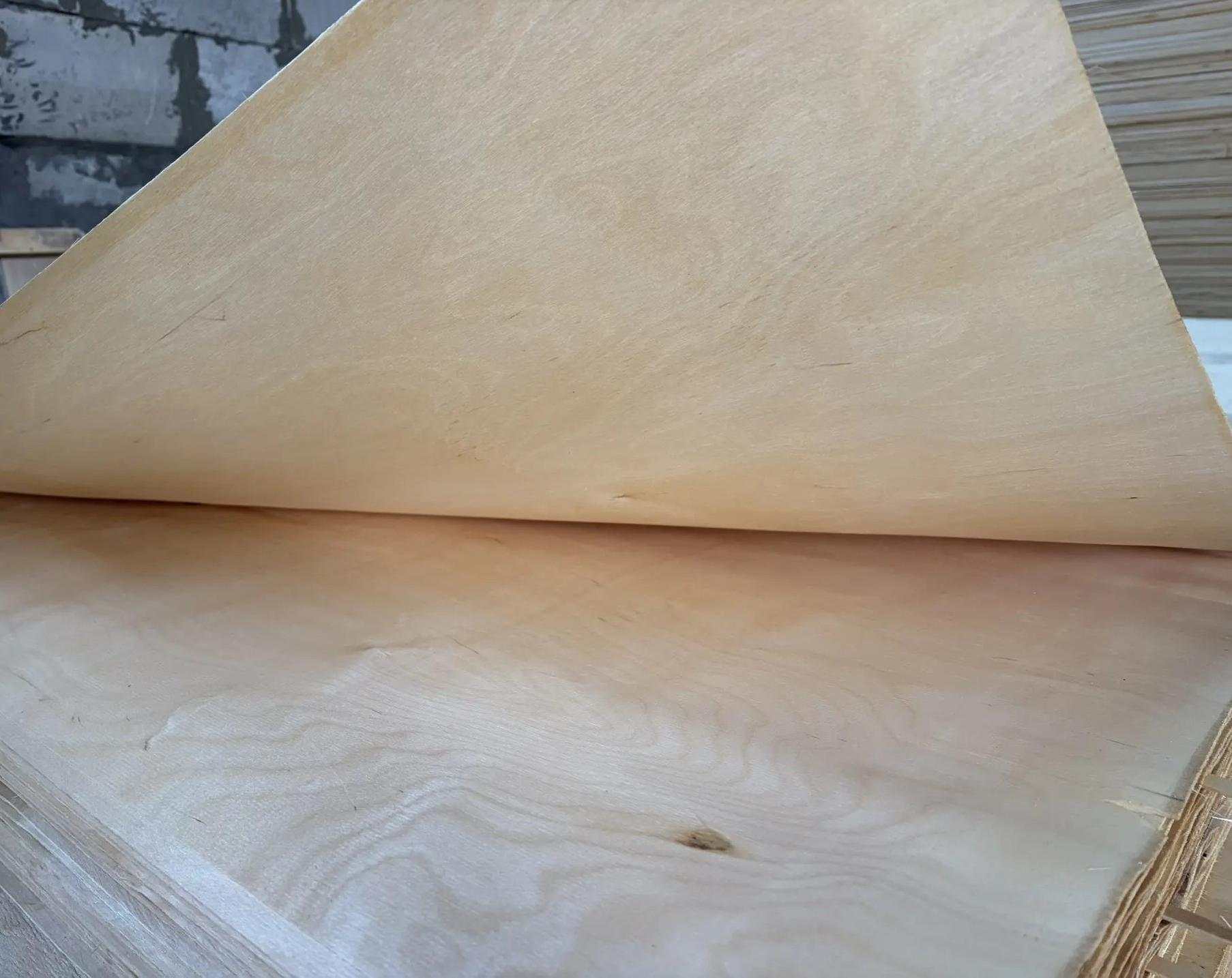
Surface of a rotary-cut birch veneer sheet — light, uniform grain

Technical data

ParameterValue
SpeciesBirch, Betula (Udmurtia)
HS code4408.90
Nominal thickness1.5 mm (0.9–1.7 mm on request)
Moisture content5–8%
GradeMixed 1–4
Grade 1–2 share22–27% (50% in 420 × 420 blanks)
Density620–680 kg/m³
Bending strength120–144 N/mm²
SurfacePeeled, dried, graded — not sanded

Moisture content: the work behind the number

The industry standard after drying is 8–10%. We ship at 5–8% and we measure and document it separately.

The difference turns into money in two places. In transit: temperature swings inside a closed container over a 22–32 day passage produce condensation, and green veneer moulds within 25–40 days where dry veneer does not. In the press: a narrow moisture band stabilises glue consumption and press time, so your unit cost does not jump from batch to batch.

Two grading systems, often confused

This is the most frequent source of confusion in the Turkish market.

Veneer grade (what we sell): 1, 2, 3, 4, or a stated proportion in a mixed batch. It reflects log quality, knot and split density, and surface cleanliness.

Plywood panel face grade (what you produce): B/BB, BB/BB, BB/CP, CP/CP, C/C. It describes the two faces of the pressed panel.

They are related but not the same. Producing a B/BB panel needs high-grade veneer on the face while grades 3–4 can go into the core. That is exactly why a mixed 1–4 batch covers both face and core needs in a single order — and it is the whole logic of buying mixed.

Tolerances and acceptance

Every shipment carries a packing list and the measurement record for that batch: moisture, thickness, sheet count, m², m³, net and gross weight.

On acceptance: measure moisture with your own meter, check thickness at several points, and look at bundle edges for crushing and at whether the desiccant bags are in place.

If a deviation is ours, we compensate on the next batch or refund the difference. That is in the contract.

How quality relates to price

Prices valid as of August 30, 2026. Prices exclude VAT, ex-works.

2600 × 1300 mm
$219/ m³17,500 ₽
1.5 mm · 5–8% · Grade 1–2 22–27% · 33 m³ / 40'HC
1600 × 1600 mm
$219/ m³17,500 ₽
1.5 mm · 5–8% · Grade 1–2 22–27% · 38 m³ / 40'HC
1300 × 1300 mm
$219/ m³17,500 ₽
1.5 mm · 5–8% · Grade 1–2 22–27% · 40 m³ / 40'HC
420 × 420 mm
$374/ m³29,900 ₽
1.5 mm · 5–8% · Grade 1–2 50% · 42 m³ / 40'HC

Price by grade — Applies to all formats

GradeUSD/m³ · EXW₽/m³ · reference
Mixed 2–4$20616,500 ₽
Mixed 1–4$21917,500 ₽
Grade 1–2$43835,000 ₽
Grade 1$62550,000 ₽

The list is kept in ₽; USD is converted at the 19 Aug 2026 rate (80 ₽/$). Contracts are in USD or EUR. · HS 4408.90 · MOQ 33 m³

FAQ

Frequently asked questions

How do you designate grades?

Raw veneer uses the Russian classification: grades 1, 2, 3 and 4, or 1–4 in a mixed batch. The B/BB, BB/CP, CP/CP and C/C notation common in Turkey describes the face quality of a pressed plywood panel, not of the veneer itself. The two should not be conflated.

Why is the grade 1–2 share given as a range?

Because the log itself varies. The 22–27% band is what we can realistically commit to batch after batch. Narrowing it means tightening the sort and raising the price — grade 1–2 is sold separately at 35,000 ₽/m³.

Why does moisture content matter so much?

Two reasons. Transport: over a 22–32 day sea passage green veneer moulds and dry veneer does not. And the press: as moisture drifts, glue consumption and press time drift with it, which makes your unit cost unpredictable.

Can I get a sample?

Yes, free of charge. Five to ten sheets of each format, courier at our cost, 7–10 days. The measurement record for that batch goes with it.

What if a batch comes in below the stated quality?

We compare the actual batch against the figures on the packing list. If the deviation is ours, we compensate on the next batch or refund the difference. This is written into the contract — we do not work on verbal assurances.

Does the veneer arrive sanded?

No. This is raw veneer for the plywood press: peeled, dried and graded, with no sanding or calibration.

Tell us the format, thickness and monthly volume

We will work out the cubic metres per container, the freight to your port and the lead time. We answer during Turkish business hours, in Turkish, English and Russian.

Author: Andrey, Turkey representative, HUŞ KAPLAMA · Published: · Updated: