Where the waste actually goes
Cutting loses money in two places: the width of the cut, and the leftover area that cannot be cut into anything. The first is measured in millimetres and does not matter. The second can reach half the sheet.
The reason is plain geometry. The sheet has fixed dimensions, the piece has fixed dimensions, and if the piece does not divide into the sheet as a whole number, a strip along the edge cannot be used. That strip is inside the cubic metres you paid for.
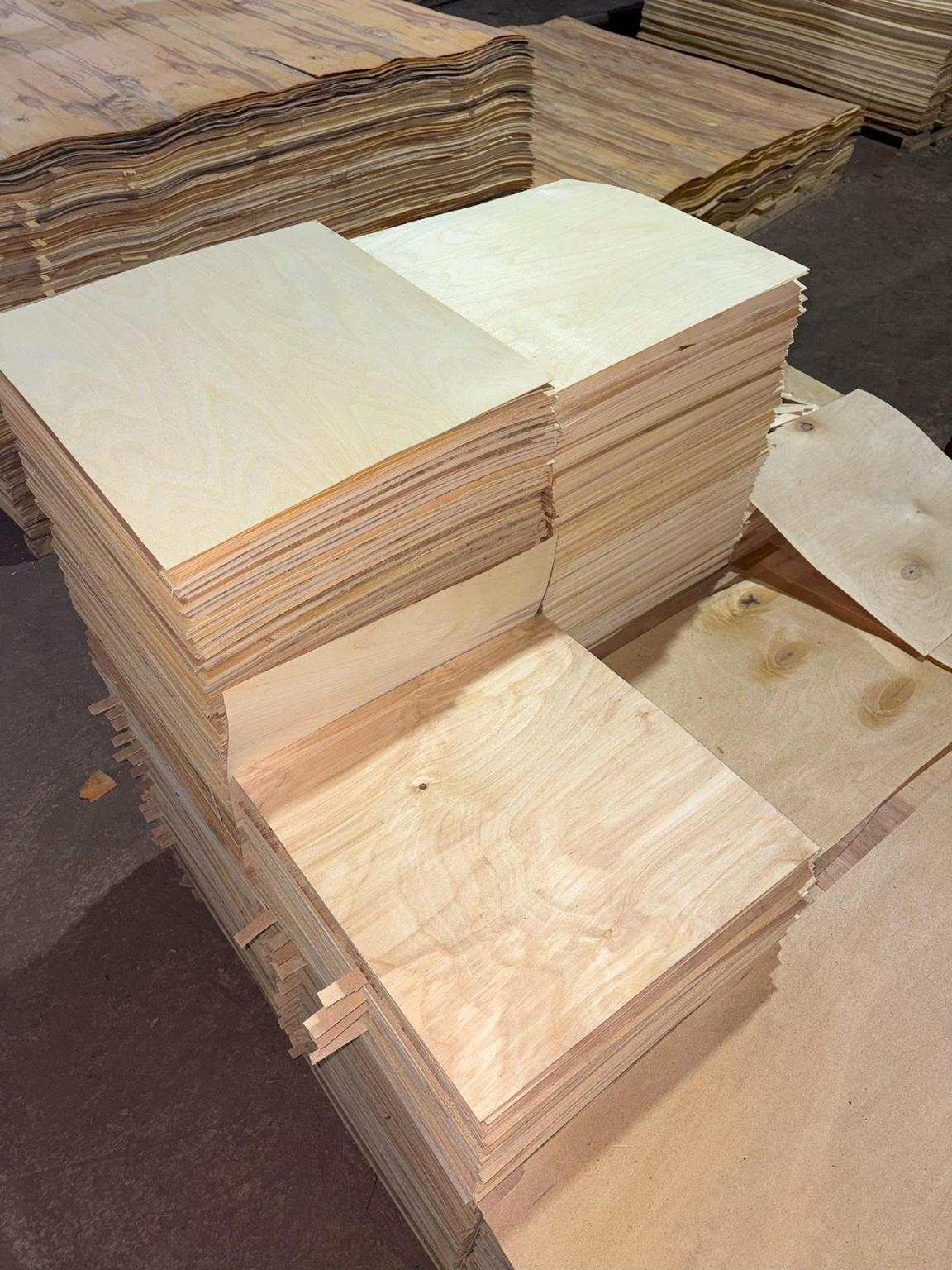
Format choice: one piece, two very different yields
The table compares the two main parent formats for commonly requested piece sizes. Yield = usable area ÷ sheet area. Sheet areas: 2600 × 1300 = 3.38 m², 1600 × 1600 = 2.56 m².
| Piece size | From 2600 × 1300 | From 1600 × 1600 | Choose |
|---|---|---|---|
| 420 × 420 | 18 pcs · 93.9% | 9 pcs · 62.0% | 2600 × 1300 |
| 500 × 500 | 10 pcs · 74.0% | 9 pcs · 87.9% | 1600 × 1600 |
| 600 × 600 | 8 pcs · 85.2% | 4 pcs · 56.3% | 2600 × 1300 |
| 700 × 700 | 3 pcs · 43.5% | 4 pcs · 76.6% | 1600 × 1600 |
| 800 × 800 | 3 pcs · 56.8% | 4 pcs · 100% | 1600 × 1600 |
| 800 × 600 | 6 pcs · 85.2% | 4 pcs · 75.0% | 2600 × 1300 |
| 1250 × 650 | 4 pcs · 96.2% | 2 pcs · 63.5% | 2600 × 1300 |
| 1300 × 650 | 4 pcs · 100% | 2 pcs · 66.0% | 2600 × 1300 |
Two rows deserve attention. On 800 × 800 mm the gap between formats is 43 percentage points: choosing the wrong parent format nearly doubles your cost per usable m³. And 1300 × 650 and 800 × 800 fit their own format exactly — zero leftover.
What cutting in-house really costs you
The list price for sheets is 17,500 ₽/m³. But when the cutting happens at your end, the cubic metres you pay for and the cubic metres you use are not the same number.
| Your yield | Cost per usable m³ | Versus sheet price |
|---|---|---|
| 100% | 17,500 ₽ | — |
| 94% | 18,620 ₽ | +6% |
| 85% | 20,590 ₽ | +18% |
| 74% | 23,650 ₽ | +35% |
| 57% | 30,700 ₽ | +75% |
Three more items sit on top of that table: cutting labour, machine depreciation and offcut disposal. All three belong in the comparison — leave them out and the arithmetic always comes out wrongly in favour of sheets.
On the other side of the ledger there is this: cutting is itself an act of grading. Knotty and split areas are separated during cutting and never enter the batch. That is why the share of grade 1–2 rises to 50% in the 420 × 420 format while sheets stay at 22–27%. Part of the premium you pay for cut pieces is the price of a cleaner product — the mechanism is set out in detail on the pre-cut blanks page.
When cutting in-house is the right call
This page is not here to sell the cutting service into every situation. Cutting it yourself comes out cheaper when:
- You have a cutting line and spare capacity on it. If your marginal cutting cost is low, paying a premium makes no sense.
- You use the offcut in another product. Packaging, filler, small components, fuel — if the leftover is genuinely not waste, the arithmetic changes.
- Your dimensions vary a lot. If every order is a different size, planning it remotely slows you down.
Letting us cut pays off when there is no cutting line, or the line is busy with more valuable work; when your dimension is fixed and repeating; and when your yield is low — because shipping that waste from Russia to Turkey costs 90–120 USD per m³.
What to send us
Three pieces of information are enough for a quote:
- Piece dimensions in millimetres, with the tolerance you expect.
- Thickness — 0.9 / 1.2 / 1.5 / 1.7 mm.
- Monthly or annual quantity, in pieces or m³.
You get two numbers back: the yield each parent format gives for that size, and the price per cut m³. If there is any flexibility in your dimension, we will also propose an alternative that raises the yield.