Two species, two different strengths
Birch and beech sit side by side in the Turkish market: plywood in both species appears in the price lists of the large producers. Choosing between them is a real decision, and it comes down to two differences.
| Birch (Betula) | Beech (Fagus sylvatica) | |
|---|---|---|
| Density | 620–680 kg/m³ | higher than birch |
| Hardness, abrasion resistance | good | better |
| Stability under humidity | good | poor, moves noticeably |
| Colour | pale, yellowish white, uniform | pinkish brown, darkens with steaming |
| Drying | straightforward | must be slow and careful |
| Suitability for peeling | very good | good |
| Local resource in Turkey | none, imported | limited |
In short: beech is harder, birch is more stable. Whichever serves your product more is the answer.
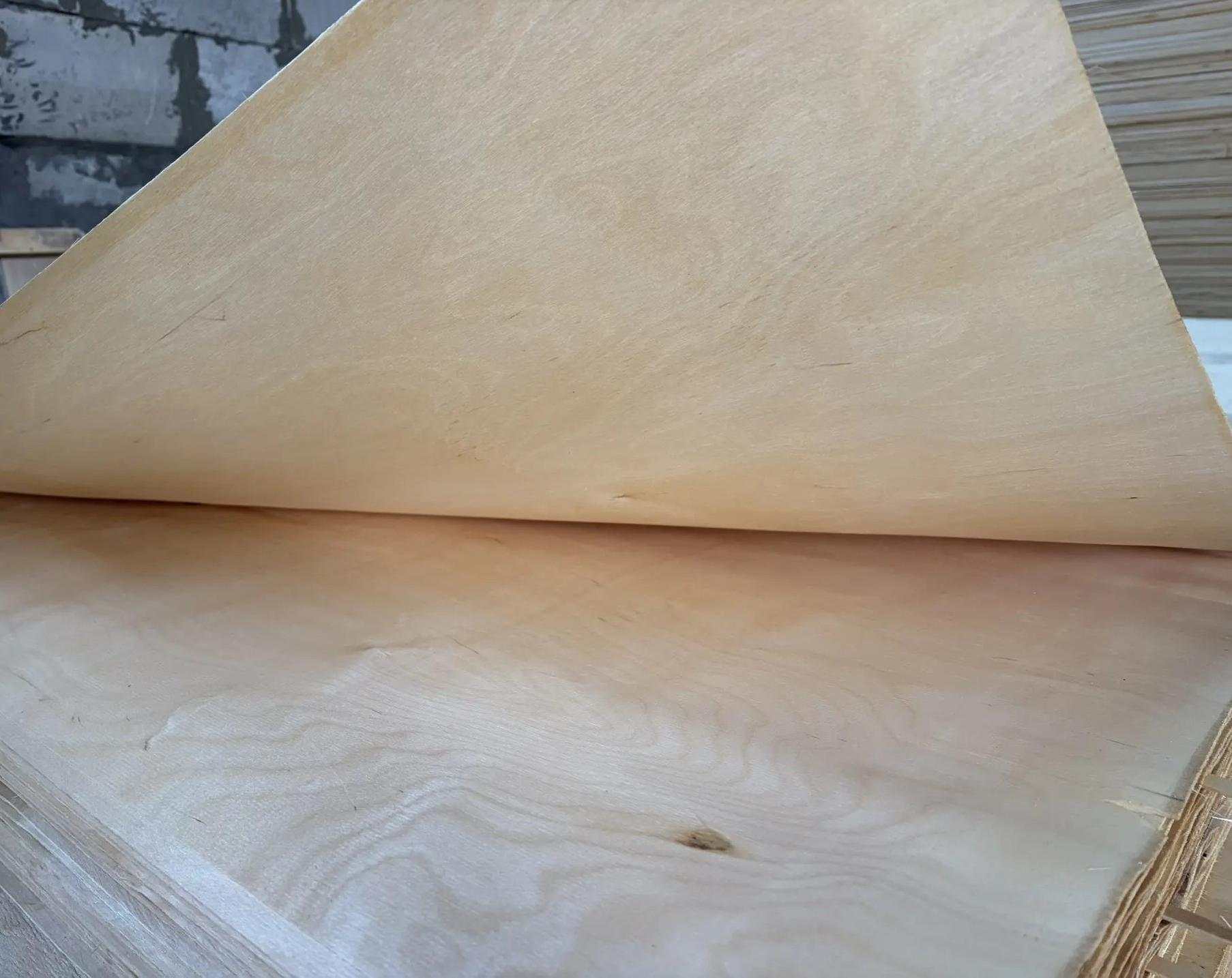
Where beech is the right answer
We do not sell beech, so saying this costs us nothing — and buying the wrong species without knowing costs you a good deal.
Wear surfaces. Table tops, stair treads, worktops — anywhere there is constant contact and friction, the hardness of beech pays off directly.
Solid components. Chair legs, frames, handles. Here the material works as mass rather than as a layer, and density decides.
Steam bending. The technique was built historically around beech and the species suits it. Birch bends by a different route — thin plies glued in a mould, that is bent lamination.
Dark-toned finishes. The pinkish cast of beech causes no trouble under dark varnish; if anything it gives a warm ground.
In those four cases, if what you need is beech, we are not the right supplier.
Where birch is the right answer
Plywood plies. A panel holding its dimensions depends on its plies holding theirs. The movement of beech under humidity works directly against it here: if the plies move differently, the panel accumulates stress. That is why birch is so widespread in general-purpose plywood.
Anywhere a pale finish is required. Clear lacquer, light-toned paint, a natural look — the yellowish-white, uniform grain of birch sits well under all of them. The pinkish cast of beech shows through a pale finish.
Bent lamination. Short, even fibre lets thin plies take the curve in a mould without breaking.
As the face ply. The layer that ends up under paint after pressing; uniform grain and a clean surface decide here. The detail is on the door panel page.
Stability under humidity: this is the real difference
The most practical difference between the two species is not hardness but dimensional stability. Beech is among the timbers that change dimension most as they dry and swell.
In a solid component that is a manageable question, solved through the drying regime and the direction of cut. In a layered product it works differently — a panel cannot be more stable than the plies inside it. When humidity changes and the plies move differently, internal stress builds, and it surfaces either as warping or as delamination.
Birch’s advantage here is that it holds its dimensions better once dried. The target band for industrial veneer is 5–8%, and as long as that band holds, the panel behaves predictably — see the moisture content page.
The price side
Our rotary-cut birch veneer is 17,500 ₽/m³ ex-works, mixed grade 1–4, roughly 219 USD/m³. Graded 1–2 is 35,000 ₽/m³.
We do not quote a current price for beech veneer, because we do not sell it — if we cannot verify a figure we do not publish it. Two things belong in any comparison: freight next to the veneer price (90–120 USD per m³ on an imported item) and the grade distribution (a mixed 1–4 lot yields 22–27% grade 1–2). The full price table is on the prices page.
Three questions that settle it
- Is the material working as a wear surface or as a layer? Wear surface, beech; layer, birch.
- Is the finish pale? If it is, birch; under dark varnish the gap narrows.
- Is the product exposed to changing humidity? If so, stability dominates, and birch leads there.
If all three answers point to beech, then beech is the right material. Saying that costs us nothing: an order that goes out in the wrong material is more expensive than an order that was never placed.