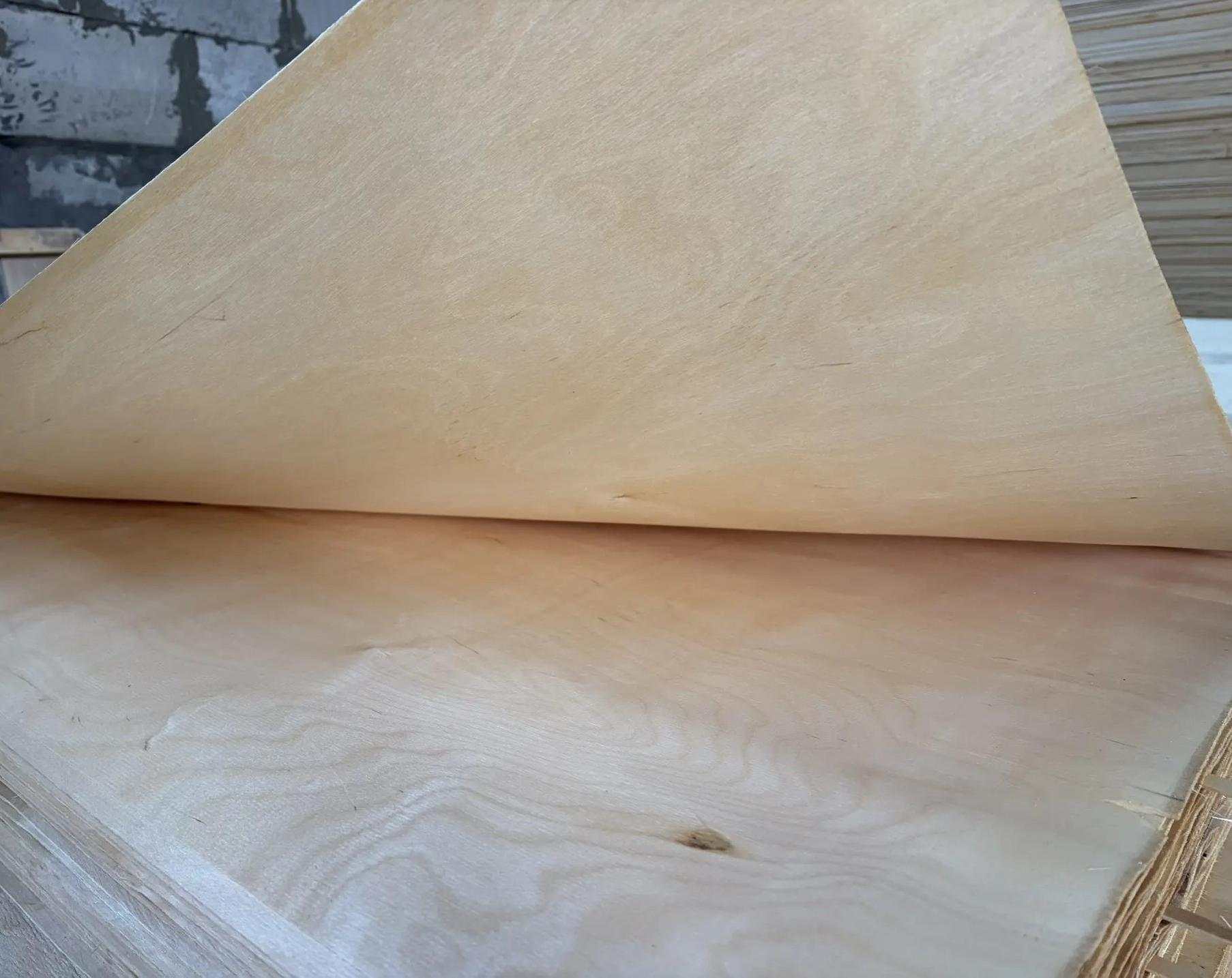
How a plywood panel is built
Plywood is veneer laid up crosswise and bonded under a press. One rule governs everything: the grain of adjacent layers runs at 90° to each other.
Solid timber is strong along the grain and weak across it. Cross the layers and the weak direction of each one is backed every time by the strong direction of its neighbour. The result is comparable strength in both planes, plus the dimensional stability that solid timber does not have — the panel does not move with humidity.
This is why the layer count is always odd. Three, five, seven, nine, eleven. With an even count the grain on the two faces would run in different directions, and the panel would cup to one side as it dried.
Working out the layer count
The question that comes up most often in practice: how many layers of veneer go into a panel of a given thickness.
| Panel thickness | Layers at 1.5 mm veneer | Typical use |
|---|---|---|
| 4 mm | 3 | Furniture backing, packaging |
| 6–8 mm | 5 | Furniture, door infill |
| 9–12 mm | 7–9 | Carcass furniture, interior |
| 15 mm | 9–11 | Formwork, furniture, general construction |
| 18 mm | 11–13 | Formwork — the highest-volume thickness |
| 21–30 mm | 15–21 | Heavy formwork, flooring, marine |
Why we give a range. Each layer loses roughly 5–8% of its thickness under the press, and the sanding allowance comes off on top of that. Eleven layers × 1.5 mm is 16.5 mm green thickness, which comes out of the press at around 15 mm. The exact figure depends on your pressure and glue consumption — which is why the lay-up is slightly different at every plant.
Face and core: this is where the money is
The economics of plywood fit into one sentence: good veneer on the visible face, cheap veneer inside.
Only the two outer layers of a panel are visible, and the surface class is assigned on those alone (B/BB, BB/CP, CP/CP). The inner layers are never seen, and only two things are asked of them — strength and even thickness. A knot, a small split or a colour difference is not a problem in the core.
This is why a mixed grade 1–4 batch is a deliberate product, not a cheap compromise. A single order yields veneer for both the face and the core:
| Layer | Grade required | Share of the batch |
|---|---|---|
| Outer faces (2 layers) | Grade 1–2 | 22–27% in a mixed batch |
| Inner layers | Grade 3–4 | The remainder |
In our standard batch the grade 1–2 share is 22–27%. In an eleven-layer panel two layers are face and nine are core, so the real requirement is about 18%. The band sits above your requirement, which is why you do not need to buy face veneer separately.
For producers who want a cleaner surface we also sell grade 1–2 on its own; prices are further down this page.
Combi construction — the most common answer in Turkey
Birch face, poplar core. Birch hardness and its pale, even texture on the outside; poplar cost on the inside.
It is widespread in Turkey because poplar is local: it grows in Sakarya, Düzce and Kocaeli on a 10–15 year rotation, and it is 30–40% cheaper than birch. Birch is imported — from Russia and Scandinavia.
A mixed 1–4 batch fits combi production precisely: grade 1–2 birch goes to the face, and grade 3–4 birch goes in as an intermediate layer between the poplar.
Moisture and glue
Moisture content is the most treacherous variable in the shop. Too high and the press generates steam, raising the risk of delamination. Too low and glue absorption breaks down, weakening the bond.
The industry standard after drying is 8–10%. We ship at 5–8% and send the measurement record with the packing list on every batch. The practical benefit is a single one: on veneer held to a narrow moisture band, glue consumption and press time settle down, which means your unit cost does not jump from batch to batch.
Glue choice follows the application:
| Glue | Where | Properties |
|---|---|---|
| UF (urea-formaldehyde) | Interior, furniture | Cheap, pale, not water-resistant |
| PF / WBP (phenol-formaldehyde) | Formwork, exterior, marine | Water-resistant, dark glue line |
| MUF | Intermediate class | Humid interiors |
The emission class (E1, E0) is set by the glue formulation. It comes from the adhesive, not from the veneer.
The production run — where the veneer comes from
- Log preparation. Hydrothermal treatment softens the wood; the bark is removed.
- Peeling. The log rotates and the knife takes off a continuous ribbon — hence the name rotary-cut veneer.
- Clipping and grading. The ribbon is clipped to format and the sheets are sorted by grade.
- Drying. Moisture is brought down to 5–8%.
- Despatch — the point at which the veneer passes from us to you.
- Glue spreading, lay-up, pressing, sanding, trimming to size — that is your side of the line.
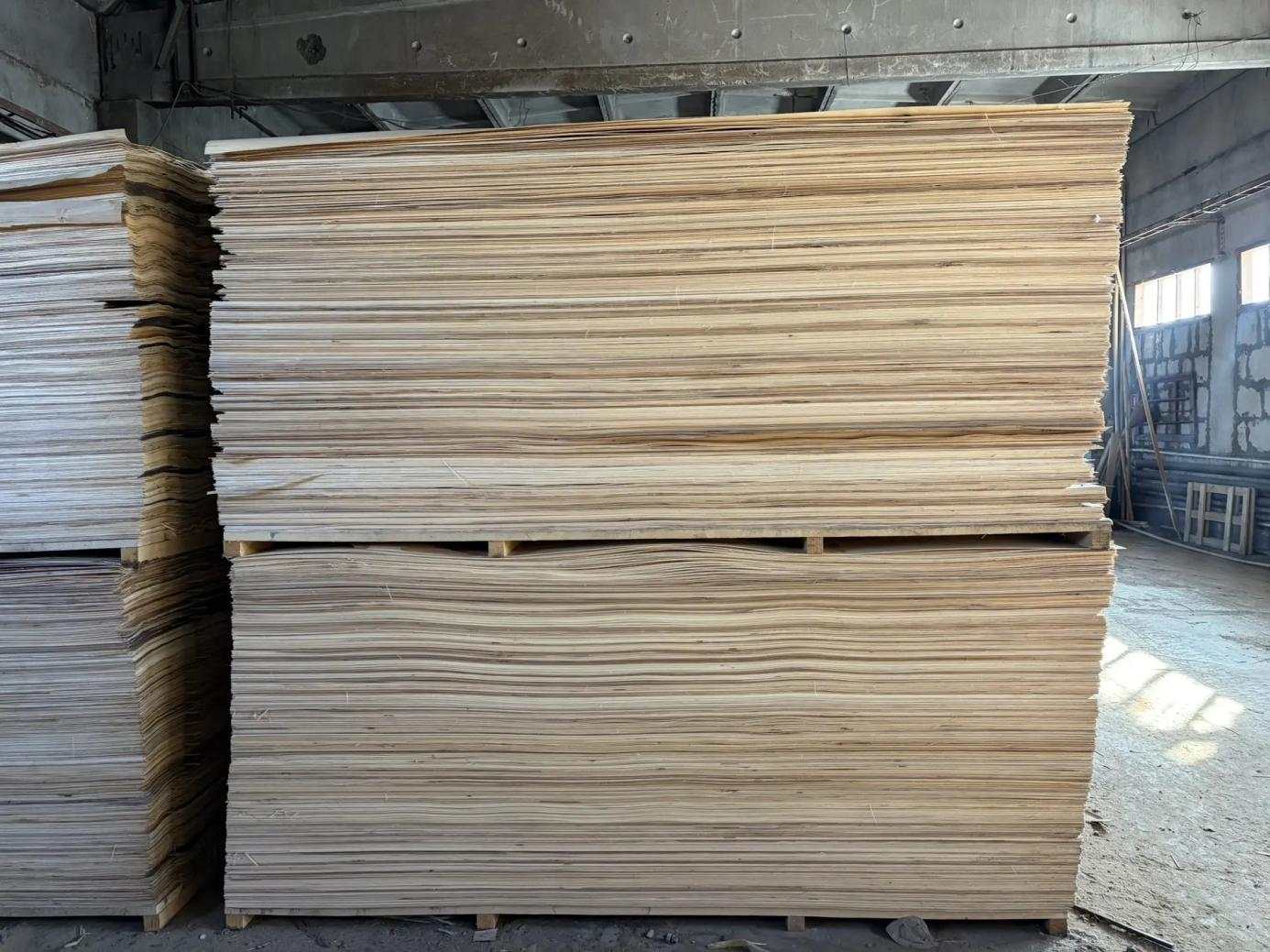
The first five steps are done at our site in Udmurtia, and shipping goes out from our own rail siding. A railcar holds 102 m³.
Prices
Prices valid as of August 30, 2026. Prices exclude VAT, ex-works.
Price by grade — Applies to all formats
| Grade | USD/m³ · EXW | ₽/m³ · reference |
|---|---|---|
| Mixed 2–4 | $206 | 16,500 ₽ |
| Mixed 1–4 | $219 | 17,500 ₽ |
| Grade 1–2 | $438 | 35,000 ₽ |
| Grade 1 | $625 | 50,000 ₽ |
The list is kept in ₽; USD is converted at the 19 Aug 2026 rate (80 ₽/$). Contracts are in USD or EUR. · HS 4408.90 · MOQ 33 m³
One practical note on choosing a format: a 2600 mm bundle does not clear the 2352 mm internal width of a 40’HC and can only be loaded lengthwise. If you are shipping by container, the 1600 × 1600 format carries 15% more goods on the same freight. The full calculation is on the logistics page.