What plywood is, and why the plies are crossed
Solid wood behaves differently along each axis: it is strong along the grain, markedly weaker across it, and it moves across the grain as humidity changes. Plywood answers that directly — it glues thin veneer plies on top of one another with the grain of each running at right angles to its neighbour.
The result is a panel that is balanced in both directions, because every ply covers its neighbour’s weak axis. The same principle stabilises the panel against humidity: movement is locked in by the crossed plies.
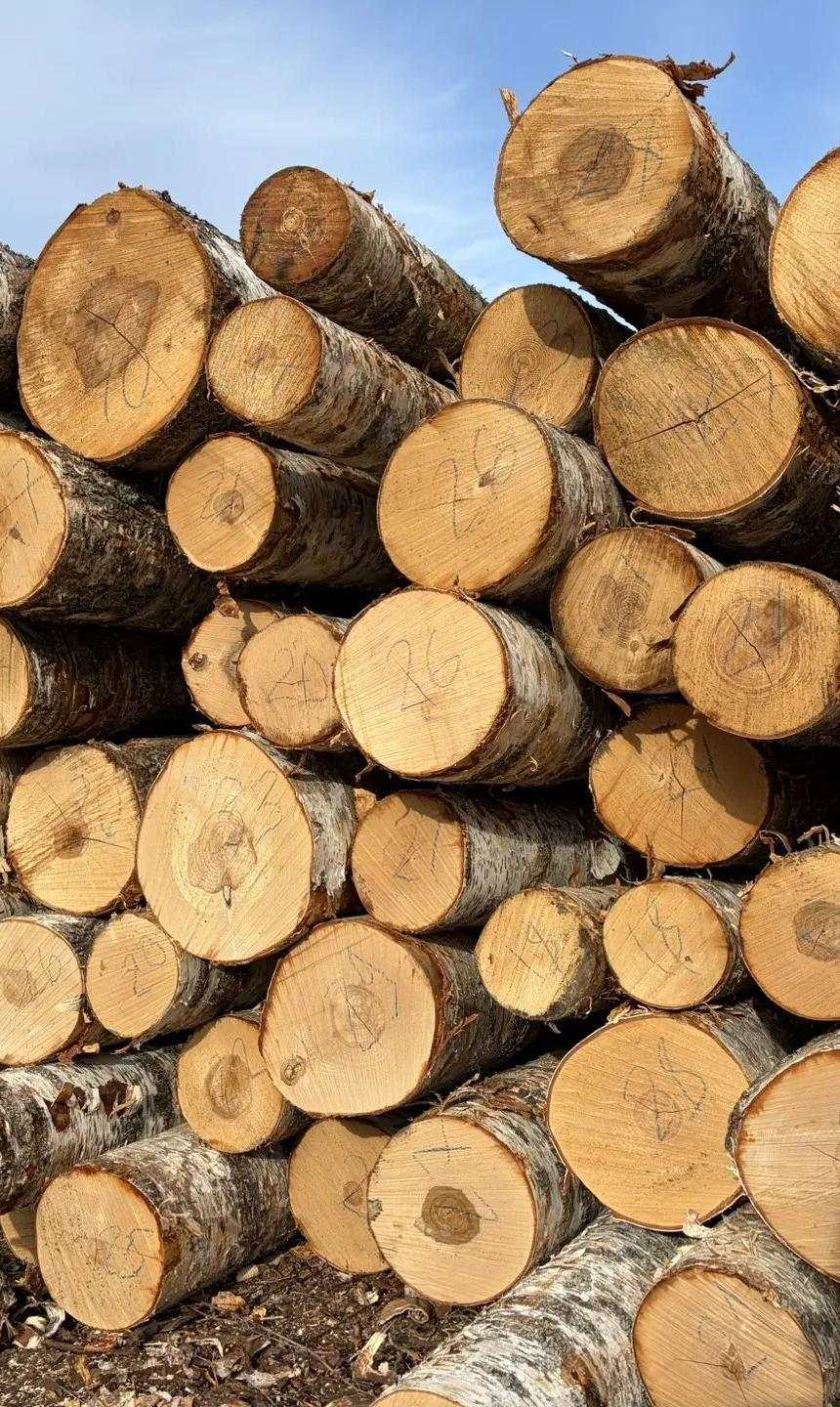
The production stages: thirteen steps
| # | Step | What happens |
|---|---|---|
| 1 | Debarking, bucking | The log is stripped of bark and cut to the length the lathe accepts |
| 2 | Hydrothermal treatment | Hot water vat or steam; the wood softens so the knife cuts cleanly |
| 3 | Peeling | The log rotates against a fixed knife, producing a continuous ribbon of veneer |
| 4 | Clipping to format | The ribbon is cut to sheet size; edges and narrow strips are separated out |
| 5 | Drying | Moisture is brought down to the 5–8% band; adhesion depends on it |
| 6 | Grading | Sorting by knots, splits and colour |
| 7 | Jointing, patching | Narrow strips are edge-jointed, fallen knots replaced with patches |
| 8 | Adhesive application | Roller line; one face or both, depending on the build |
| 9 | Lay-up | Plies stacked in an odd number with the grain crossed |
| 10 | Cold pre-pressing | The pack consolidates, plies seat, the stack becomes handleable |
| 11 | Hot pressing | Heat and pressure cure the adhesive; the panel is formed here |
| 12 | Conditioning | Internal stress and moisture equalise; cut too early, the panel moves |
| 13 | Trimming, sanding, grading | Edges cut, thickness calibrated, final grading and marking |
Mills merge some steps and split others, but the order never changes, because each step consumes the output of the one before it.
Thickness and ply count
Birch plywood builds are standardised: as thickness rises, the ply count moves up in odd numbers. The last column shows how much of the finished panel one ply occupies — nominal thickness divided by ply count.
| Panel thickness | Plies | Ply thickness in panel |
|---|---|---|
| 4 mm | 3 | 1.33 mm |
| 6.5 mm | 5 | 1.30 mm |
| 9 mm | 7 | 1.29 mm |
| 12 mm | 9 | 1.33 mm |
| 15 mm | 11 | 1.36 mm |
| 18 mm | 13 | 1.38 mm |
| 21 mm | 15 | 1.40 mm |
| 24 mm | 17 | 1.41 mm |
The practical value of that last column is this: the gap between it and the veneer thickness you feed in is the sum of press compression and sanding allowance. Making a 15 mm panel from 1.5 mm veneer, that gap is 0.136 mm per ply — roughly 9%.
Which veneer property shows up at which step
Panel quality is largely input quality. Four parameters, each surfacing in a different place.
| Parameter | Where it shows | What deviation costs |
|---|---|---|
| Moisture 5–8% | In the hot press | Excess water turns to steam and collects at the glue line: blisters, delamination |
| Thickness tolerance | At lay-up and pressing | Plies that do not hold thickness make the panel wavy and waste material at calibration |
| Grade: knots, splits | On the face plies | Defects read through after sanding; in the core they cause no trouble |
| Jointing quality | On the face and at the edge | A poor joint marks the panel face and opens a gap at the edge |
That is why a plywood mill buys veneer against four numbers rather than one price. Which thickness and grade belong where is covered on the veneer for plywood production page; what the grade letters mean is on grades; how moisture is measured is on the moisture content page.
Birch, poplar and combi builds
Using two species in one panel is common and sensible, because the plies do different jobs.
- Face plies are visible and carry load. Birch is preferred here: 620–680 kg/m³, bending strength 120–144 N/mm², pale and uniform grain.
- Core plies are never seen. Poplar is adequate there and makes the panel lighter; grown locally in Turkey, it is also cheaper.
- Combi builds put the two together: birch faces, poplar core. The panel comes out cheaper and strong enough.
Turkey has no industrial-scale birch forest, so birch veneer is imported, while poplar is grown on the Sakarya and Düzce plains. The species comparison is on the birch versus poplar page.
Standards
Plywood is described by two separate systems, and buyer and seller often speak different ones: Russian production works to GOST, the Turkish buyer talks in TS EN. Grade letters, dimensional tolerances and emission classes do not map one to one between them. How the two line up is set out on the standards page.
Where we sit in this chain
We do not make or sell plywood. What we produce is the output of step three: rotary-cut birch veneer, dried, graded and clipped to format. The first five steps of the chain finish with us; everything from step six is yours.
This page was written to be a reference while you set up a line or make a sourcing decision. What size, thickness, grade and moisture mean on the veneer side is on our product pages.