What you are actually buying: not having a cutting line
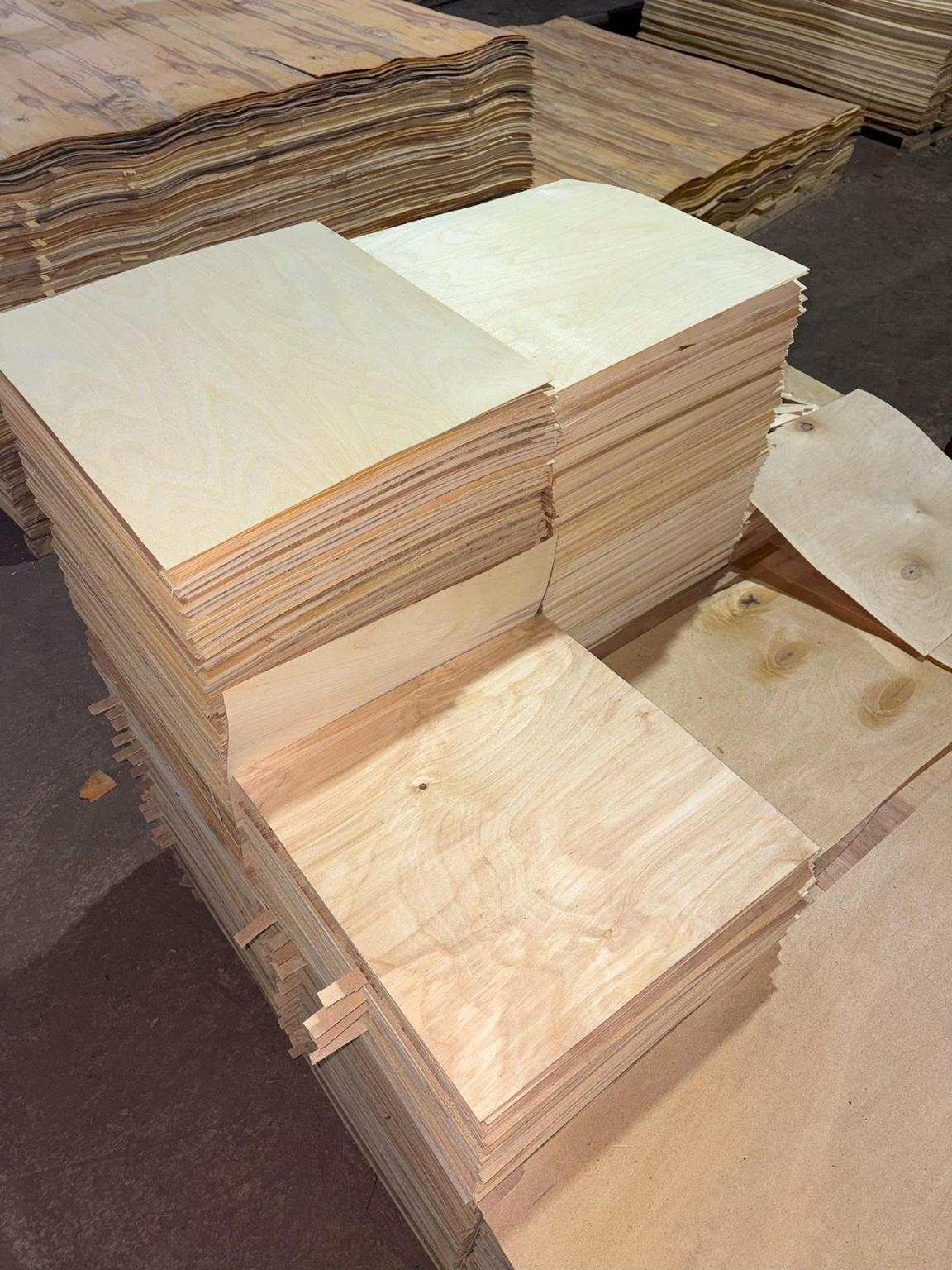
Technically the 420 × 420 mm blank is the same birch veneer as everything else we make — same logs, same line, same moisture band. One thing is different: the cutting is done at our end.
Which means what you are buying is not wood but a process step removed from your shop. It makes sense for producers who have no cutting line, and for those who have one but would rather give its hours to higher-value operations.
Who buys these squares: furniture frames and bent lamination
The format explains itself. 420 × 420 mm is enough for a chair seat, a backrest, a case side panel or a small bent-laminated part — and none of those needs a 2600 × 1300 mm sheet.
The largest group of buyers is bent lamination: squares are stacked in a mould, glued and pressed into a curve to become a chair seat or backrest. The square format has two advantages here. First, the mould wants a square area to begin with — cutting that area out of a rectangular sheet is waste by definition. Second, in series production one format covers many models: the same 420 × 420 square becomes a different product in a different mould, and the warehouse holds a single stock item.
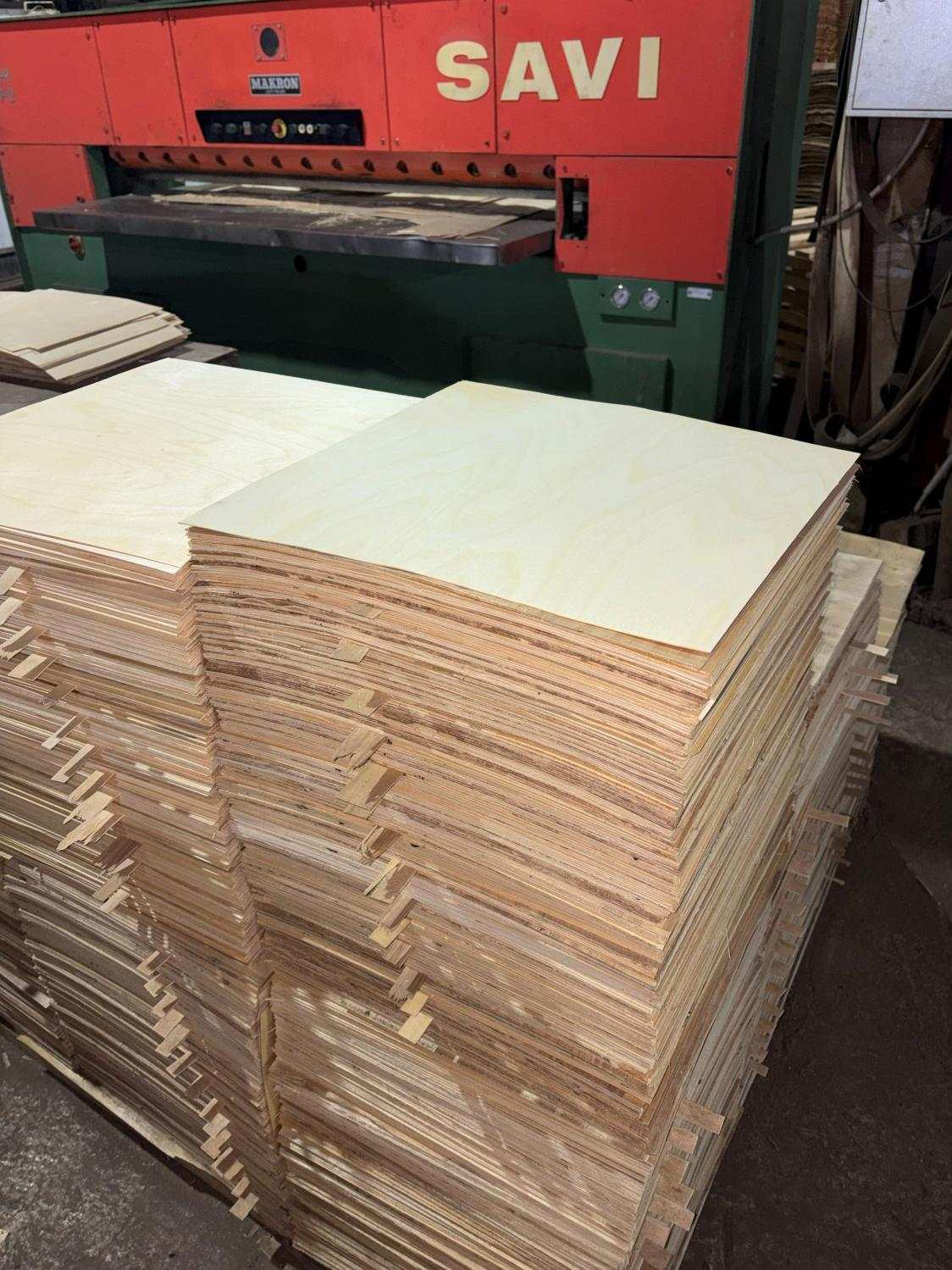
At 1.5 mm, one square is 0.1764 m² and 0.0002646 m³. A cubic metre yields roughly 3,779 pieces — so at 29,900 ₽/m³ that is about 7.9 ₽ per piece (≈ 0.10 USD). In series production it is easier to think in that unit: however many plies a chair seat eats, that is your input cost.
What the premium really is
On the list the gap between 29,900 ₽ and 17,500 ₽ is 71%. But those are not comparable numbers, because buying sheets and cutting them yourself still loses you part of the cubic metre. The fair comparison looks like this.
| Item | Buy sheets and cut them yourself | Pre-cut blanks |
|---|---|---|
| List price | 17,500 ₽/m³ | 29,900 ₽/m³ |
| Cutting waste | ≈ 6% (18 blanks out of a 2600 × 1300 sheet, 94% area use) | 0 |
| Cost of a usable m³ | ≈ 18,620 ₽/m³ | 29,900 ₽/m³ |
| Cutting labour and machine depreciation | yours | ours |
| Grade 1–2 share | 22–27% | 50% |
| Fits in a 40’HC | 33 m³ | 42 m³ |
| Freight per m³ (container ≈ 3,960 USD) | 120 USD | 94 USD |
| CIF per m³, approximately | ≈ 353 USD | ≈ 468 USD |
Net premium: roughly 115 USD per cubic metre. What that buys is the cutting work, the machine, the labour planning and — the item people forget most often — the sorting out of defects.
Technical data
| Parameter | Value |
|---|---|
| Size | 420 × 420 mm (±5 mm) |
| Thickness | nominal 1.5 mm; band 0.9–1.7 mm (±0.1 mm) |
| Species | Birch (Betula) |
| Moisture content | 5–8% |
| Grade | Mixed, grade 1–2 share 50% |
| Density | 620–680 kg/m³ |
| GTİP (Turkish customs tariff code) / HS | 4408.90 |
| One blank | 0.000265 m³ · 0.176 m² |
| 1 m³ | 3,779 pieces · 667 m² |
| 40’HC container | 42 m³ ≈ 158,700 pieces |
| Railcar | 102 m³ ≈ 385,400 pieces |
| Price | 29,900 ₽/m³ ex-works ≈ 374 USD/m³ |
When sheet format is the better buy
The purpose of this page is not to sell blanks into every situation. Sheet format works out cheaper in three cases.
- You already run a cutting line and its capacity is not fully taken. Then cutting costs you almost nothing at the margin and there is no reason to pay a premium.
- Your part size is not 420 × 420 and your own waste ratio is low.
- You put your offcut to work in another product — packaging, filler, fuel.
Send us the hourly cost of your cutting line and your monthly requirement in cubic metres, and we will lay the two scenarios side by side. If the answer comes out in favour of sheets, we will say so.
Applications
| Sector | Why pre-cut blanks |
|---|---|
| Bent lamination: seats, backrests | The mould wants a square area; one format covers many models |
| Furniture frames | Repeating small components in series; a cutting line is not worth building |
| Matches and sticks | The finished article is small already; a cutting line is a separate investment |
| Small packaging, crate components | Low-volume, high-variety production — a line does not pay for itself |
| Toys and giftware | High appearance requirements, so the 50% grade 1–2 share is worth real money here |
| Feeding a lamination line | The line takes blanks directly; the intermediate cutting step is redundant |
| Internal furniture parts | Small components at a standard size |
What bent lamination specifically demands — how many plies, which thickness, why moisture is critical — is on the bent lamination page. For the furniture segment as a whole, see the furniture page.
Ordering
Send us your finished blank size, the thickness and your monthly requirement in pieces. 420 × 420 is our standard size and is planned from stock; for any other size we price separately according to the offcut it produces.