The mould wants a square; the sheet is a rectangle
The input to bent lamination is simple: veneer plies of a given size, a given thickness and low moisture. They go into a mould, take glue, go under press — and a stack of flat plies becomes a chair seat or a backrest.
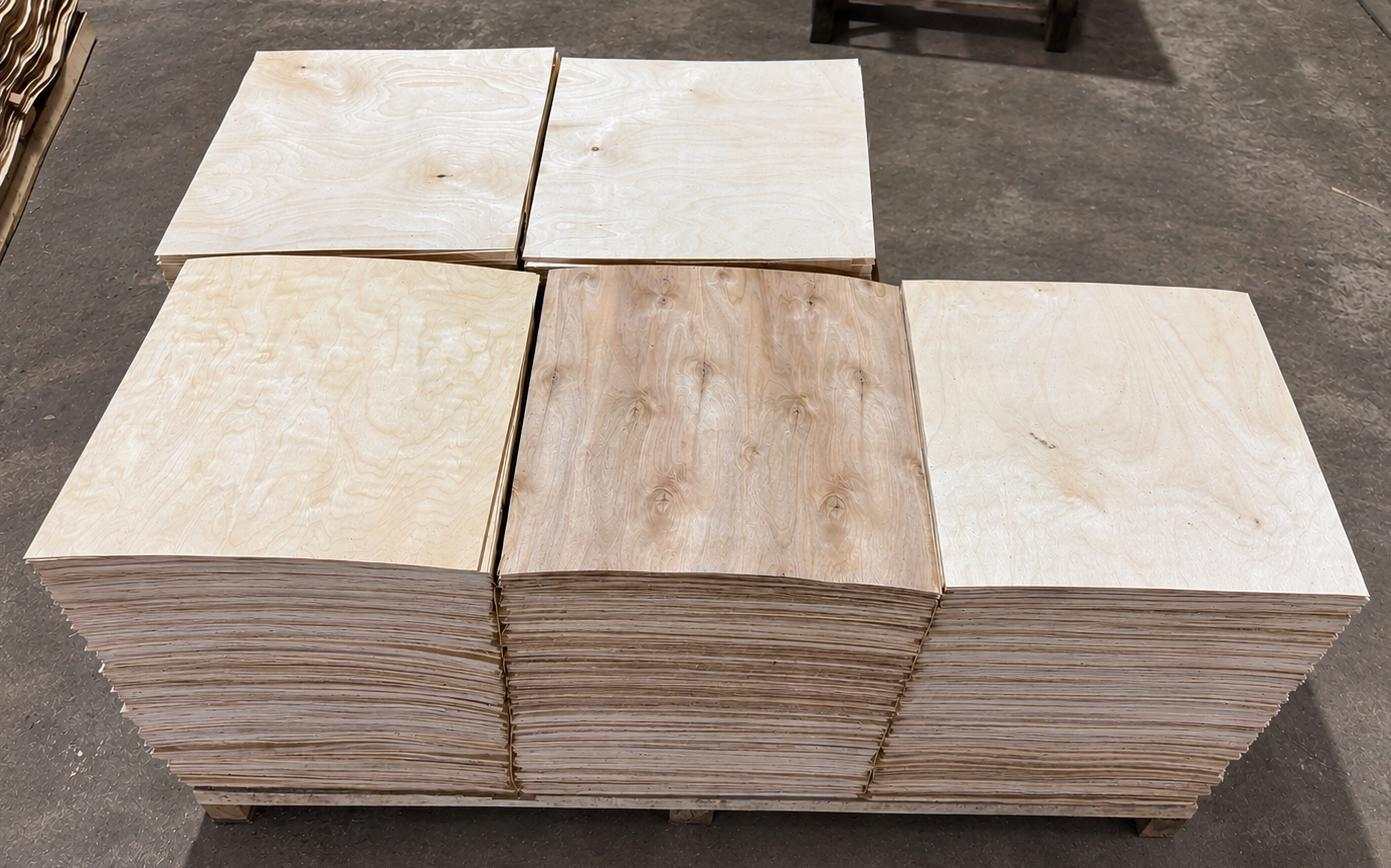
The problem is not the input but the format it arrives in. The area the mould wants is square; the sheet you buy is a rectangle. You close that gap yourself every time: you cut, an unusable strip stays along the edge, and that strip is already inside the cubic metres you paid for.
Ply count and cost per piece
In bent lamination it is easier to think about cost per ply rather than per cubic metre. At 1.5 mm one square is 0.1764 m² and 0.0002646 m³ — so a cubic metre yields roughly 3,779 pieces, which at 29,900 ₽/m³ is about 7.9 ₽ apiece.
| Target thickness | With 1.5 mm | With 1.2 mm | Ply cost (1.5 mm) |
|---|---|---|---|
| 8 mm | ≈ 5 plies | ≈ 7 plies | ≈ 40 ₽ |
| 10 mm | ≈ 7 plies | ≈ 8 plies | ≈ 55 ₽ |
| 12 mm | ≈ 8 plies | ≈ 10 plies | ≈ 63 ₽ |
| 15 mm | ≈ 10 plies | ≈ 13 plies | ≈ 79 ₽ |
The table is dry arithmetic on nominal thicknesses: compression in the press depends on glue, pressure and dwell time, so the final thickness has to be confirmed on your own line. The point here is not an exact figure but the order of magnitude of your input cost, visible at a glance.
Grade: cutting is the sorting
A mixed 1–4 batch runs 22–27% grade 1–2. In cut squares the same figure rises to 50%, and the cause is not an extra operation but the nature of cutting: knotty and split areas are separated as the piece is cut and never enter the batch.
In bent lamination that difference has a concrete meaning. You need top grade for the outer plies that end up visible, and you do not need it for the inner ones. Because the top-grade share doubles in squares, one batch can feed both.
Moisture: risk grows with ply count
Heat cures the glue in the press, and excess water in the veneer turns to steam. In a flat panel the steam has somewhere to go; in a curved part with a high ply count it does not. The result is blistering, or worse, delamination that only shows up under first load.
Our band is 5–8%. It is measured before dispatch and written on the shipping document, so you can compare the declared figure against your own meter on arrival. How the measurement is taken and why the band sits where it does is on the moisture content page.
One warning: material leaves at 5–8% but picks up moisture in storage. Do not open the film until the stock goes to the mould — the packaging page covers it.
What we supply and what stays with you
Setting this boundary out plainly removes most of the misunderstandings that otherwise appear later.
| Ours | Yours |
|---|---|
| Format and cutting tolerance | Mould design |
| Grading and top-grade share | Lay-up scheme and grain direction |
| Thickness and its tolerance | Glue selection |
| Moisture and the measurement record | Press regime: pressure, temperature, dwell |
| Packaging and shipping | Confirming final thickness |
We do not advise on glue, moulds or press regimes — advice in a field we do not work in helps nobody. Supplying the input repeatably is our job.
What to send us for a quote
- Square size — 420 × 420 mm or something else.
- Thickness — 0.9 / 1.2 / 1.5 / 1.7 mm.
- Monthly quantity in pieces or m³, for batch planning.
- Any specific grade expectation for the outer ply — if there is one, we will price graded material separately.
Before a series order a sample makes sense: there is no reason to decide without trying the material in your own mould with your own glue.